


Only 13% of Marketing Qualified Leads convert to Sales Qualified Leads — meaning 87 out of every 100 leads your marketing team works to generate are effectively dead on arrival. For B2B organizations investing heavily in pipeline growth, that number isn't just disappointing. It's a structural failure.
The root cause is often a "spray and pray" approach to lead generation: volume prioritized over precision, with marketing teams passing contacts to sales based on surface-level engagement signals rather than genuine buying intent. According to Flint, 61% of B2B marketers send all leads directly to Sales, yet only 27% of those leads are actually qualified. The result is a fractured funnel where sales reps burn time chasing contacts who were never ready to buy.
Callout: When unqualified leads flood a sales pipeline, reps learn to distrust marketing output entirely and the MQL to SQL conversion rate deteriorates further with each ignored handoff.
The B2B tech leader at the center of this case study faced exactly that scenario. Their marketing function was generating high volumes of inbound leads, but sales rejection rates were climbing and response times were lagging. The cost wasn't just measured in wasted outreach; it was reflected in eroding revenue confidence, strained cross-functional relationships, and a pipeline that looked healthy on paper but consistently underdelivered at close.
Understanding why the funnel breaks is the first step — but the deeper problem lies in how leads are scored and how quickly teams act on them.
Poor sales and marketing alignment is often the root cause of conversion collapse, not lead volume, budget, or channel mix.
As SiriusDecisions (Forrester) notes, "the biggest reason for low MQL-to-SQL conversion is a lack of a shared definition of a 'qualified lead' between Sales and Marketing." For this B2B tech company, that misalignment was systemic. Marketing scored leads on engagement signals — webinar attendance, content downloads while Sales prioritized budget authority and purchase timeline. The result was a pipeline full of contacts that looked warm on paper but were cold in practice.
Stale data compounded the problem. When outreach relies on contacts that have changed roles, companies, or priorities, even well-timed messages land in the wrong inbox. In practice, B2B contact data decays at roughly 25–30% annually, meaning a list that's six months old has already lost a quarter of its accuracy. For a B2B data provider UK was relying on static exports, this was a structural liability.
And speed mattered just as much as accuracy. Harvard Business Review research shows that waiting just five minutes to respond to a lead decreases the odds of qualifying them by 10x. The company's average response window? Over four hours. Together, these gaps created a compounding failure — bad data reaching the right person too late, or accurate data reaching the wrong person at all.
The real diagnostic insight here: conversion problems are rarely about lead quantity — they're about data quality and the speed of follow-through.
Switching from static, broad-based prospect lists to real-time data was the single most impactful decision this B2B tech leader made — and it reshaped every step of their pipeline.
The team partnered with B2Bdrum as their B2B data provider UK to replace outdated contact exports with continuously refreshed firmographic and intent signals. That shift made it possible to tighten lead qualification criteria around factors that actually predicted conversion: company size, tech stack, hiring signals, and recent buying intent. Leads that didn't meet the threshold simply didn't enter the funnel.
From there, scoring became automated. Rather than relying on rep intuition or manual tagging, the system weighted each incoming prospect against a predefined model — and flagged high-fit accounts for immediate outreach. And because the data stayed current through real-time updates, bounce rates dropped and deliverability held steady across scaled email sequences.
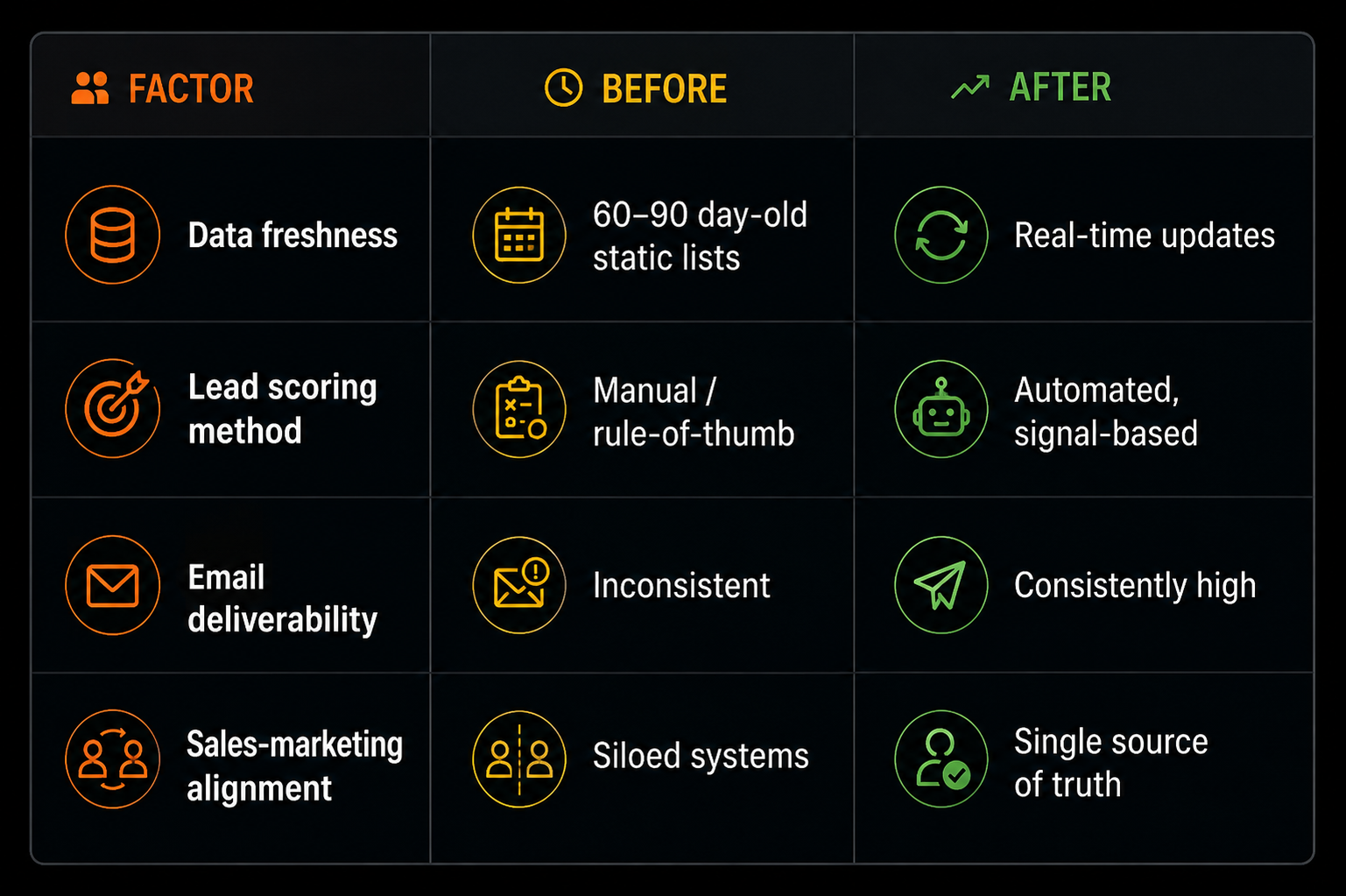
Crucially, both Sales and Marketing agreed on one shared data environment. No more competing definitions of a "qualified lead" — just one pipeline, one standard.
The infrastructure was in place; what it produced next is where the numbers get interesting.
Precision data didn't just improve metrics — it fundamentally transformed how this B2B tech leader's revenue team operated, pushing their MQL vs SQL conversion rate to nearly triple the industry benchmark.
The headline result: a 35% MQL to SQL conversion rate, compared to the widely cited industry average of around 13%. That's not incremental improvement. That's a structural shift in pipeline quality.
The most visible change was friction reduction. Sales reps stopped wasting time on prospects who were never a fit to begin with. Morale improved noticeably once reps recognized that the leads arriving in their queue were genuinely worth pursuing. And when salespeople trust their pipeline, they work it harder.
Pipeline predictability followed naturally. With fewer surprises at each funnel stage, forecasting became reliable rather than aspirational. Leadership could finally tie marketing spend to revenue outcomes with confidence.
The rejected lead story is equally compelling. According to DojoAI research data, roughly 85% of leads are typically rejected by sales teams — a staggering waste of marketing investment. By partnering with a B2B data provider UK to serve higher-intent prospects, this company drove that rejection rate down to under 50%.
The clearest lesson here: better data doesn't just change numbers — it changes how teams behave, and that behavioral shift compounds across every stage of the funnel.
Strong B2B lead generation infrastructure separates revenue teams that scale predictably from those stuck chasing volume with little to show for it. The results covered in previous sections aren't a fluke — they're the outcome of four deliberate decisions any team can replicate.
Here's what to carry forward:
Every B2B data provider UK that teams evaluate should be assessed against these four criteria first.