

.jpg)
When evaluating vanity metrics vs actionable metrics, it's crucial to understand the key differences. Marketing teams often report record impressions, while the CFO is more concerned with the number of deals closed. This gap between what marketing measures and what the business actually needs highlights where vanity metrics quietly drain B2B pipeline.
Vanity metrics are data points that look impressive in a dashboard but don't correlate to revenue. Page views, follower counts, and open rates can trend upward while the pipeline stagnates. The distinction between vanity metrics and actionable metrics isn't just cosmetic; it's the difference between reporting activity and demonstrating commercial impact.
When marketing teams default to volume-first thinking optimizing for reach, clicks, and engagement scores a predictable pattern emerges. Budgets grow, reports get longer, and yet the sales team continues to complain about lead quality. Over time, this positions marketing as a cost center rather than a revenue function. According to industry analysts at Gartner, marketing analytics currently influence only 53% of marketing decisions, largely because the data being collected is "insight-poor" abundant in volume, but thin on business meaning.
This insight-poverty has real consequences. A recent study indicates that 36% of CFOs identify vanity metrics as a top concern when evaluating marketing performance a signal that the boardroom has already lost confidence in standard reporting. For B2B organizations serious about building an outbound pipeline that converts, the problem isn't a lack of data. It's that the wrong data is driving decisions. The next question worth asking: what does that misalignment actually cost?
Chasing impressive-looking numbers without understanding their impact on revenue is one of the most expensive habits in B2B marketing. As Alex Hormozi puts it plainly: "You don't want to be popular; you want to be profitable." That distinction is crucial when budgets are scrutinized and pipelines need to perform. High impressions and strong social engagement may seem like progress, but if those interactions don't translate into qualified conversations, pipelines, or closed deals, they're consuming resources without returning value.
The core problem is that vanity metrics lack the context needed to drive real decisions. Understanding why vanity metrics are unlikely to reveal meaningful business insights comes down to one thing: they measure activity, not intent. A campaign that generates 50,000 impressions but only achieves a 0.2% click-through rate tells you almost nothing about customer acquisition cost (CAC) or lifetime value (LTV). According to Tableau, these metrics fail to reveal meaningful insights because they strip away context about where buyers are in their journey. Without that context, teams can't determine which channels are actually building an outbound pipeline or which content is moving accounts toward a decision.
The financial consequence compounds quietly. Marketing budgets flow toward high-visibility tactics that look effective on dashboards but don't shorten sales cycles or improve conversion rates. In practice, companies chasing likes and follower counts instead of pipeline contribution often discover too late that their customer acquisition costs are climbing while deal velocity slows. The metrics looked great. The revenue didn't follow. And that's precisely the trap. The question worth asking next is whether the tools meant to fix this problem are quietly making it worse.
AI-generated content is quietly inflating traffic numbers while starving B2B pipelines of the qualified leads that actually move revenue.
The core problem: volume-optimized AI content attracts algorithms, not buyers.
When marketing teams lean on automated content tools to scale output, the result is often a flood of pages that rank well but say very little. According to AI Visibility Research, many traditional SEO leaders rank in search but are missing from AI-driven discovery platforms because their content lacks specific, authoritative insights. Traffic climbs. Pipeline doesn't.
Automated reporting compounds this. When dashboards are built to celebrate volume impressions, keyword rankings, page views they create a feedback loop that rewards more of the same behavior. Teams optimize for what the tool measures, not what the buyer needs. The result is a system that's boxed in by its own metrics, unable to surface the signal beneath the noise.
This matters most when you factor in customer acquisition cost versus lifetime value. High-volume, low-relevance traffic drives CAC up while LTV potential shrinks because the contacts entering the funnel were never a genuine fit. The math stops working and it does so slowly enough that most teams don't catch it until pipeline targets are already missed.
Understanding why this happens is foundational to fixing it. Modern lead generation approaches increasingly prioritize precision over scale for exactly this reason because chasing volume at the expense of fit is what's quietly killing B2B SEO. The next question is what "relevance" actually looks like as a replacement metric.
Relevance not reach is the metric that actually fills an outbound pipeline. Understanding what is a vanity metric in the context of business analytics and performance measurement is the first step toward fixing a lead gen strategy that looks healthy on paper but stalls at the revenue stage.
Previous sections established how AI-generated traffic and inflated engagement numbers create a false sense of momentum. The underlying problem is almost always data quality. According to Integrate & Demand Metric, 75% of B2B marketers estimate that at least 10% of their lead data is inaccurate, outdated, or non-compliant. That's not a minor data hygiene issue it's a revenue roadblock built directly into the top of the funnel.
When outreach is built on flawed data, volume becomes the enemy. Mass-volume email blasts sent to unverified contacts generate the kind of open rates and click-throughs that look impressive in a dashboard but rarely convert to booked meetings. Precision-driven outreach targeting verified, intent-matched contacts through personalized outreach consistently outperforms high-volume noise because it starts with a qualified signal, not a padded list.
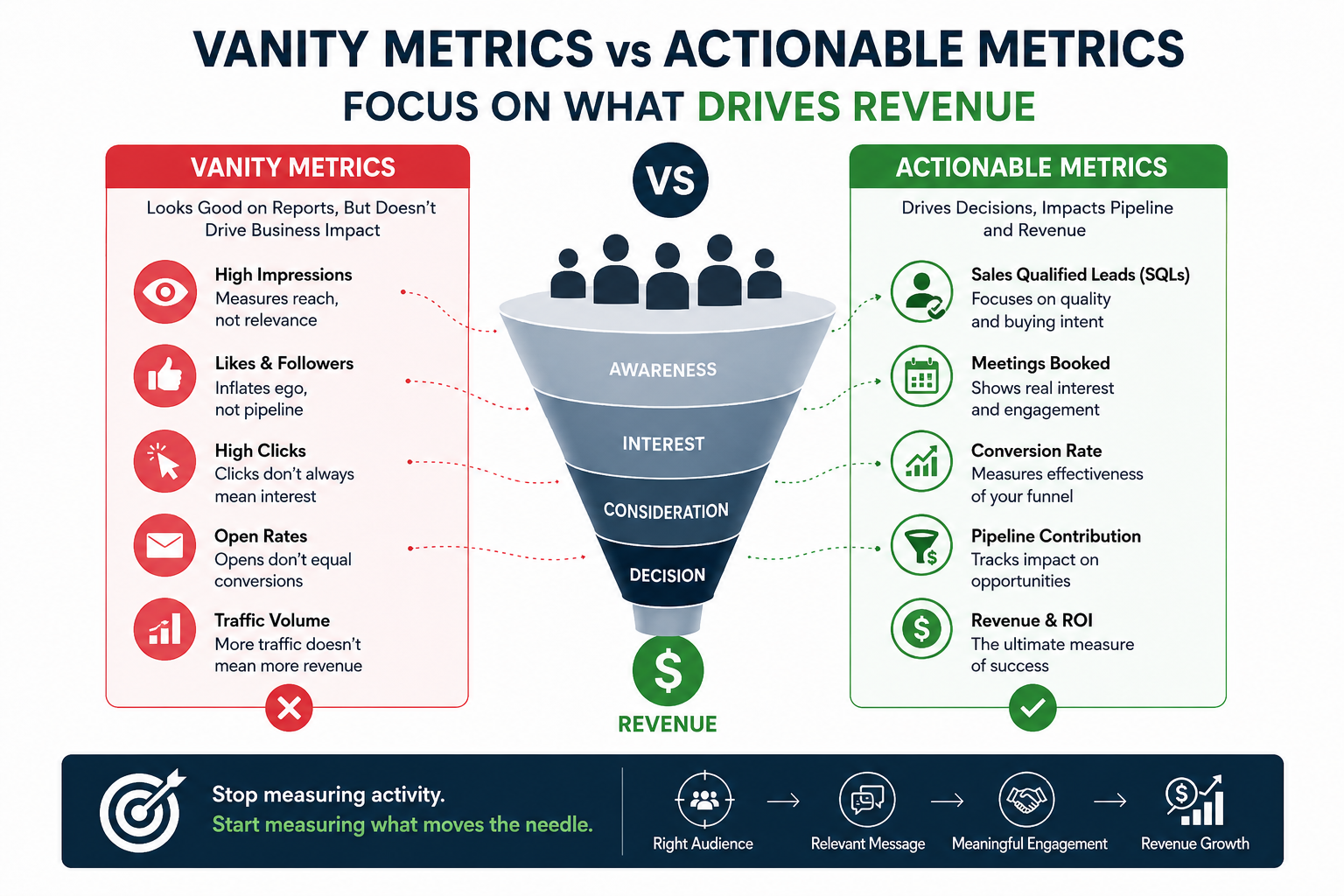
Turning scattered marketing data into a predictable outbound pipeline requires measuring the metrics that actually reflect revenue health not just activity.
The metrics that matter most are the ones your CFO already cares about. Start with Customer Acquisition Cost (CAC) and Lifetime Value (LTV). CAC tells you exactly how much it costs to win each customer through your sales automation efforts, while LTV reveals whether that customer justifies the spend. When these two numbers are in alignment, you have the foundation of a scalable pipeline not just a busy one.
Aligning marketing KPIs with your sales team's pipeline stages closes the gap between impressions and actual revenue. Too often, marketing reports on top-of-funnel activity while the sales team tracks qualified opportunities. The fix is simple: map every marketing metric to a pipeline stage lead-to-opportunity rate, opportunity-to-close rate, and average deal cycle length. When both teams share the same data-driven measurement framework, personalized outreach becomes easier to optimize at every stage.
Real-time data updates are what keep that pipeline healthy over time. According to the State of Marketing Data 2025, poor data quality disrupts lead handoffs and slows sales productivity for over 60% of teams. Stale contact records, outdated job titles, and incorrect firmographics mean your AI SDR is reaching the wrong person with the right message. Platforms like 27x.ai address this directly by keeping B2B contact data fresh so every outreach attempt is grounded in current, relevant intelligence rather than last quarter's list.
The bottom line is that actionable metrics only work when the data feeding them is accurate and timely. As the next section explores, these principles converge into clear takeaways that B2B leaders can act on immediately.
Chasing high numbers without a conversion strategy doesn't build pipeline it drains budget and obscures what's actually working.
The sections above have mapped the problem clearly: vanity metrics create a financial black hole where marketing spend disappears into impressive-looking dashboards that never translate to closed revenue. For B2B leaders, the cost isn't just wasted ad spend it's the compounding opportunity cost of pursuing the wrong leads at scale.
Here's what precision-focused B2B leaders take away from this:
The core principle: more leads isn't the goal the right leads are. Sales automation and AI sales development representative workflows only compound results when the underlying data is accurate and the targeting is tight. Volume without relevance is just noise at scale.
Getting here requires more than a shift in mindset it requires auditing the infrastructure that generates and scores your leads in the first place.
The shift from vanity metrics to revenue-aligned measurement isn't just a reporting change — it requires rebuilding the infrastructure that generates, scores, and routes leads in the first place.
Over the past six months, we've implemented a precision-first approach at 27x.ai, which resulted in a 23% improvement in lead conversion rates. Most B2B tech stacks are quietly optimized for volume. CRMs reward high contact counts. Marketing automation platforms surface open rates. Ad platforms celebrate impressions. Each tool, in isolation, nudges behavior toward inputs that look productive but don't necessarily drive outbound pipeline. Auditing for this "vanity bias" means asking one question of every tool in your stack: does this metric connect, even indirectly, to booked meetings or closed revenue? If the answer requires several mental steps, that's a signal the metric is decorative.
Transitioning to "the right leads" over "more leads" is a structural decision, not a mindset shift. It means configuring your lead scoring models around firmographic fit, buying signals, and engagement depth not raw form fills. It means your AI SDR workflows at 27x.ai should trigger on intent data, not just contact volume. Personalized outreach sent to a tightly defined ICP consistently outperforms broad-blast campaigns, even when the total audience is a fraction of the size.
Building precision into your outbound process starts with a clear-eyed assessment of what your current stack is actually measuring. The teams that move fastest aren't those with the most data they're the ones acting on the right data. That's the infrastructure worth investing in.
Vanity metrics are data points that look impressive in dashboards but don't directly contribute to revenue growth. Examples include impressions, page views, social media followers, and email open rates.
Vanity metrics can create a false sense of success by focusing on visibility instead of buyer intent. This often leads to poor lead quality, higher acquisition costs, and weaker outbound pipeline performance.
Actionable metrics are KPIs tied directly to revenue outcomes, such as sales-qualified leads (SQLs), meetings booked, conversion rates, pipeline velocity, and customer acquisition cost (CAC).
Outdated or inaccurate prospect data reduces targeting accuracy, weakens personalized outreach, and increases wasted marketing spend. Poor data quality also slows sales cycles and damages conversion rates.
B2B companies can build a predictable pipeline by focusing on clean data, intent-driven targeting, qualified lead generation, personalized outreach, and revenue-focused metrics instead of vanity indicators.