Most UK businesses don't lose deals becausetheir product is weak. They lose them because the right person heard from themonce, heard nothing afterwards, and chose someone who stayed in touch.
B2B lead nurturing fixes that gap. It is the steady, relevant follow-up that keeps your company in view while a prospect works out whether, when and with whom to buy. In this guide, we explain how UK companies can build a nurturing programme around three practical channels: massemail, 1:1 outreach and LinkedIn outreach. We also cover UK compliance, timingand the numbers worth tracking.
Lead nurturing is the process of building a relationship with a potential customer before they are ready to speak to sales. In B2B, that matters more than in consumer markets because:
• Purchases usually involve several people, such as a budget holder, an end user and someone from IT or finance.
• Sales cycles often run for weeks or months.
• Buyers tend to research quietly and only reply when a problem becomes urgent.
So the goal of nurturing is not to push harder. It is to make sure that when the need becomes real, your name is the first one that comes to mind.
UK decision-makers are busy, and their inboxes are crowded. Even so, email and LinkedIn remain the two places where professionals expect to receive business messages. They work well together:
• Email is direct, measurable and easy to scale.
• LinkedIn adds a human face, shows your credibility and lets prospects check who you are in seconds.
By combining the two, you reach the same person in two different settings, which raises recognition without raising pressure.
Each of B2BDrum's core services plays a different role. Think of them as three gears that turn at different speeds.
Mass email lets you speak to a large, well-defined list at once. Used well, it is the engine of awareness and ongoing contact.
Best used for:
• Introducing your company to a new segment
• Sharing useful content such as guides, benchmarks and case studies
• Announcing offers, events or webinars
• Re-engaging contacts who have gone quiet
How to make it work:
• Segment before you send. A message to"UK finance directors at companies with 50 to 250 staff" will be at a message to "everyone" almost every time.
• Write for one person. Even when 2,000 people receive the email, it should read as if it were written for one.
• Lead with the reader's problem, not your company history.
• Keep one clear call to action. One link or one question is enough.
• Protect your sender reputation. Authenticate your domain (SPF, DKIM, DMARC), clean your lists and avoid sudden jumps in volume.
Where mass email gives you reach, 1:1 outreach gives you depth. These are personally written messages sent to a small number of high-value prospects.
Best used for:
• Target accounts you most want to win
• Senior contacts who ignore anything that looks like a campaign
• Following up after someone clicked, replied or attended an event
How to make it work:
• Research for five minutes. Look at the company's recent news, hiring, product launches or challenges in their sector.
• Make one specific observation, then connect it to a problem you can help with.
• Keep it short. Three to five sentences is usually plenty.
• Ask a small, easy question rather than requesting a 30-minute meeting straight away.
• Follow up with new value, such as a relevant article or a short insight, not just "bumping this to the top of your inbox".
LinkedIn outreach is where prospects decide whether you seem like a real, trustworthy partner. It also gives you a gentler way to start a conversation.
Best used for:
• Warming up prospects before or alongside an email sequence
• Reaching people who rarely answer email
• Building a network of relevant contacts over time
How to make it work:
• Fix your profile first. A clear photo, a headline that states who you help and a short, outcome-focused summary matter more than any message template.
• Send a short connection note that explains why you're connecting. Avoid pitching in the very first message.
• Engage before you ask. Like or commenton a prospect's posts, then message them once the connection is accepted.
• Share value in follow-ups. Offer auseful resource or a point of view, then suggest a conversation when it feelsnatural.
• Stay within LinkedIn's rules. Aggressive automation can get accounts restricted, so keep daily volumes sensible.
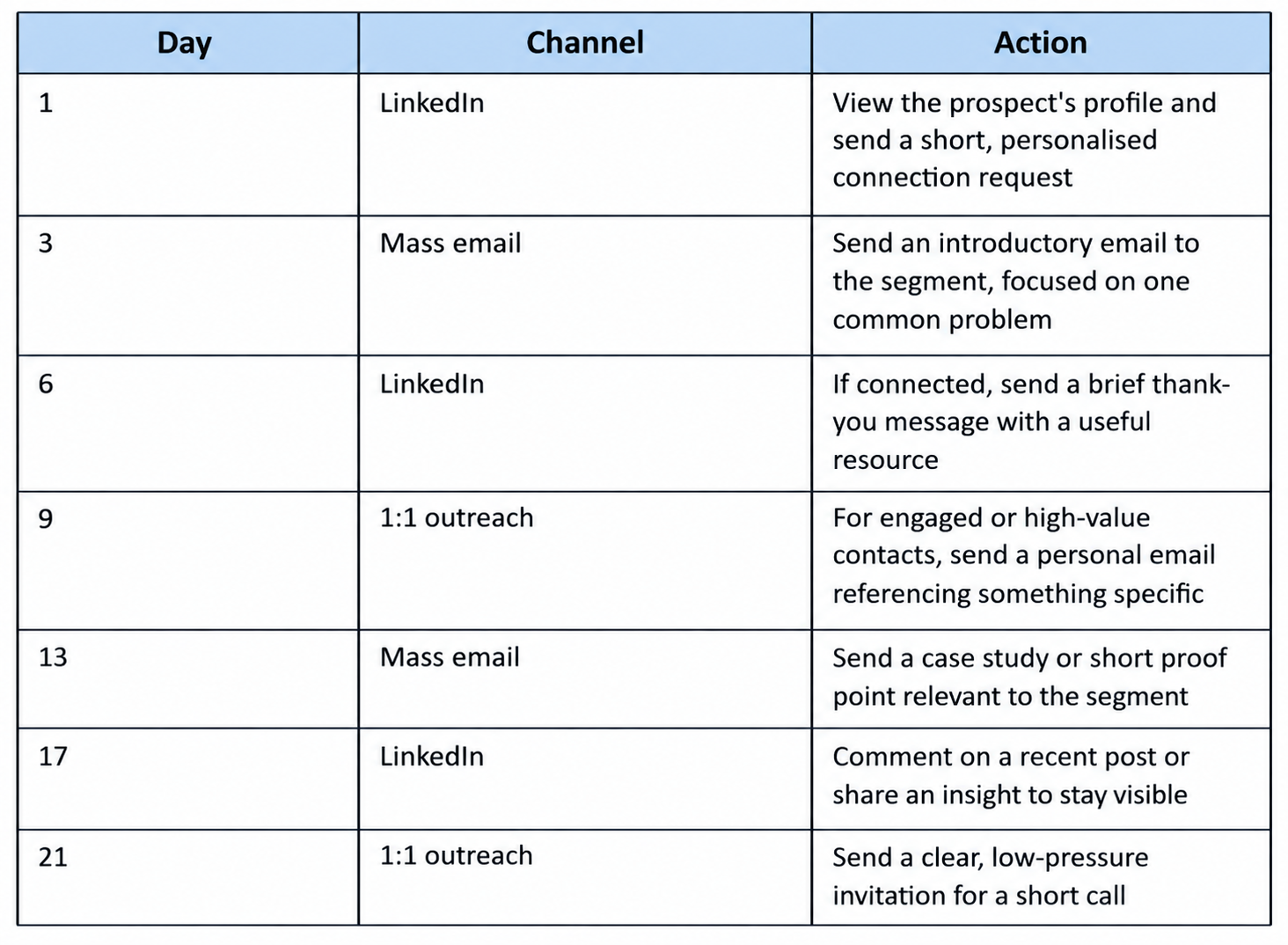
Here is an example of how the three services can support each other. Adjust timing to suit your sales cycle.
A strategy that works in another country may not work here, or may not even be legal. Keep these points in mind:
• PECR and GDPR apply. In the UK, rules on electronic marketing sit alongside data protection law. Marketing to corporate subscribers (for example, a named person at a limited company) is generally treated differently from marketing to individuals such as sole traders and some partnerships, so know which you are contacting.
• Offer a clear opt-out in every email and honour it promptly.
• Be transparent about who you are and why you are getting in touch.
• Keep accurate records of where your data came from and how you use it.
• Respect UK business culture. Messages tend to land better when they are polite, understated and specific rather thanloud and over-promising.
This is general information, not legal advice. If you're unsure, check the ICO's guidance or speak to a data protection professional.
"Hi {first name}" no longer counts as personalisation. Prospects can spot it instantly. More useful signals include:
• Role and seniority: a managing director and a marketing manager care about different things.
• Industry context: regulation, seasonality and common pain points differ across sectors.
• Company stage: a start-up and an established firm need different messaging.
• Recent activity: a funding round, a new hire, an expansion or a product launch gives you a natural reason to get intouch.
• Engagement: someone who opened three emails is warmer than someone who has never replied.
There is no universal best time to send, sotest with your own audience. As a starting point for UK B2B:
• Tuesday to Thursday morningsoften perform well.
• Avoid Friday afternoons and bank holiday weeks.
• Space follow-ups by two to fourdays at first, then lengthen the gap.
• Stop or pause when someonereplies, even if the reply is "not now".
Don't judge success by opens alone,especially because privacy features can distort them. Look at the full picture:
• Deliverability: inbox placement and bounce rate
• Reply rate: the single most useful signal for outbound
• Positive reply rate: replies that show real interest
• LinkedIn acceptance and response rates
• Meetings booked and meeting-to-opportunity conversion
• Pipeline value influenced by outreach
• Unsubscribe and complaint rates: an early warning that your targeting or tone is off
Review these monthly, change one variable at a time, and keep what works.
1. Pitching in the first message. Start by being useful or relevant.
2. Buying huge, untargeted lists. Quality and fit beat volume.
3. Using the same message for every segment.
4. Giving up after one email. Most replies come after a follow-up.
5. Running channels separately. Email and LinkedIn should support each other.
6. Ignoring the replies. Fast, thoughtful responses win deals.
Nurturing demands research, copywriting, list management, deliverability know-how and consistent follow-up. Many UK teams find that this pulls their sales people away from selling. A specialist email lead generation partner cantake on the heavy lifting.
At B2BDrum, we run mass email campaigns, 1:1 outreach and LinkedIn outreach designed to put you in front of the right decision-makers and start qualified conversations.
It is the practice of building relationships with potential business customers through relevant, ongoing communication until they are ready to talk to sales.
That depends on your sales cycle. For some UK businesses it is a few weeks. For higher-value or more complex services, it can take several months.
B2B email marketing is possible under UK rules, particularly when targeting corporate subscribers, but you must be transparent, provide an easy opt-out and comply with data protection law. Always check the latest ICO guidance.
Neither wins on its own. Email gives youscale and measurability, while LinkedIn adds credibility. The strongest results usually come from using both.
Three to five touch points across email and LinkedIn is a reasonable range, provided each one adds something new.
If you'd like a nurturing programme builtaround mass email, 1:1 outreach and LinkedIn outreach, get in touch with B2BDrum. We'll help you reach the right people, with the right message, at the right time.